When someone says pipeline, your brain might imagine pipes, valves, and water flowing through a factory.
Relax. CI/CD has nothing to do with plumbing.
It’s automation taking your git push and turning it into running production code without you SSH-ing into servers or manually deploying anything.
Here’s what actually happens.
What is CI/CD?
- CI → Build + test automatically on every push
- CD → Deliver or deploy automatically to staging/production
Tools like GitHub Actions, Jenkins, and GitLab CI/CD run this workflow.
CI stands for Continuous Integration and CD stands for Continuous Delivery or Continuous Deployment.
What Happens After git push ?
1. Webhook Fires
Your Git provider sends an event to the CI system with commit details. The pipeline starts instantly.
2. Clean Runner Starts
A fresh VM, Docker container, or K8s pod spins up.
No leftovers. No works on my machine.
3. Pipeline Runs
Your YAML steps execute:
- Install dependencies- Run tests- Build app- DeployIf tests fail, everything stops. If they pass, artifacts are created.
4. Artifacts Stored
Docker images, binaries, static files versioned and tagged. Rollback is always possible.
5. Deployment
The system deploys to cloud or Kubernetes using strategies like rolling updates, canary releases, or blue-green deployments.
6. Monitor + Rollback
Health checks run. Logs stream. If something breaks, rollback kicks in.
The Flow in One Image
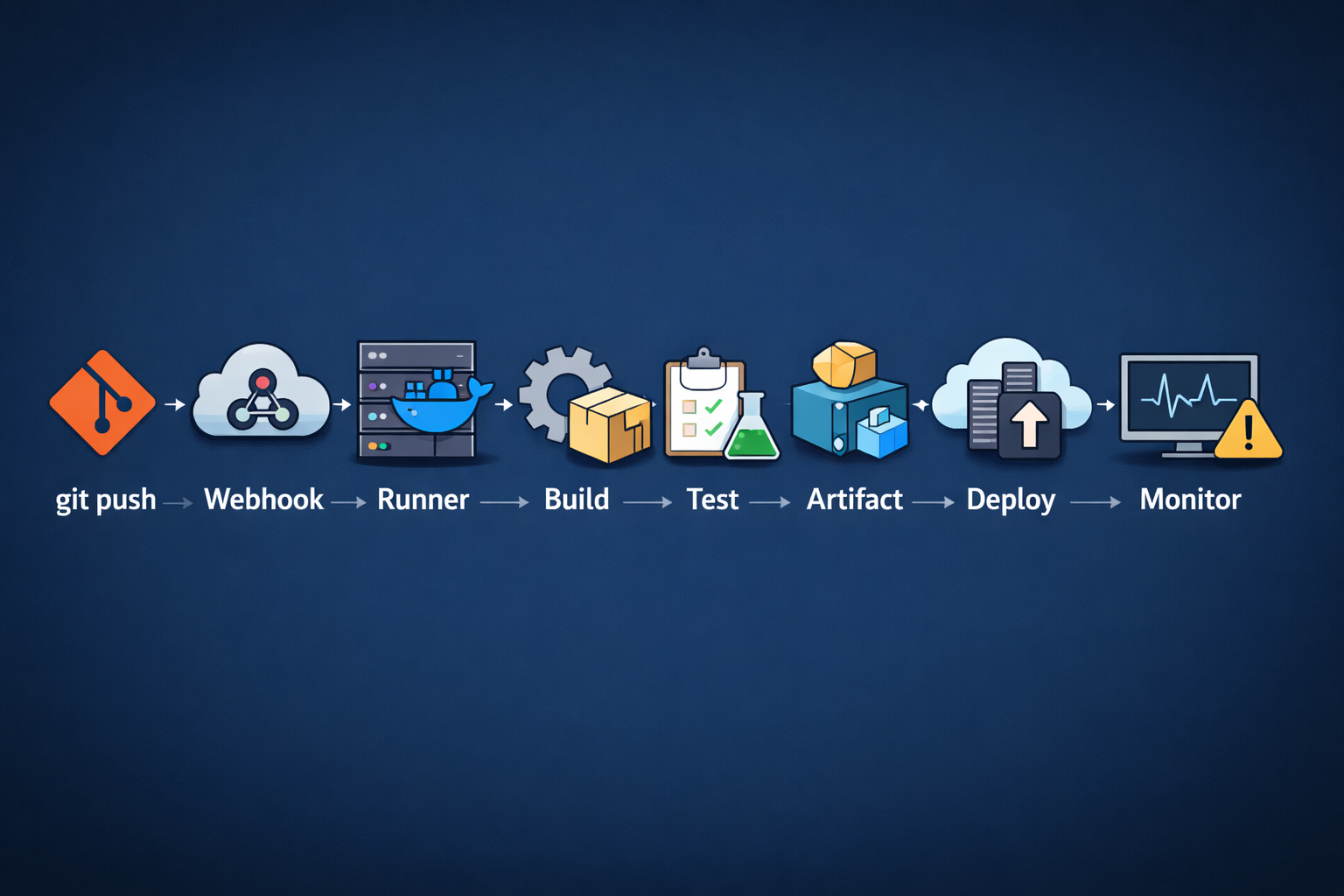
Fully automated.
Why It Matters
Without CI/CD: slow, manual, risky releases.
With CI/CD: predictable, repeatable shipping.
It’s not magic. It’s disciplined automation.
Continuous Integration is the heart of the entire DevOps lifecycle.